
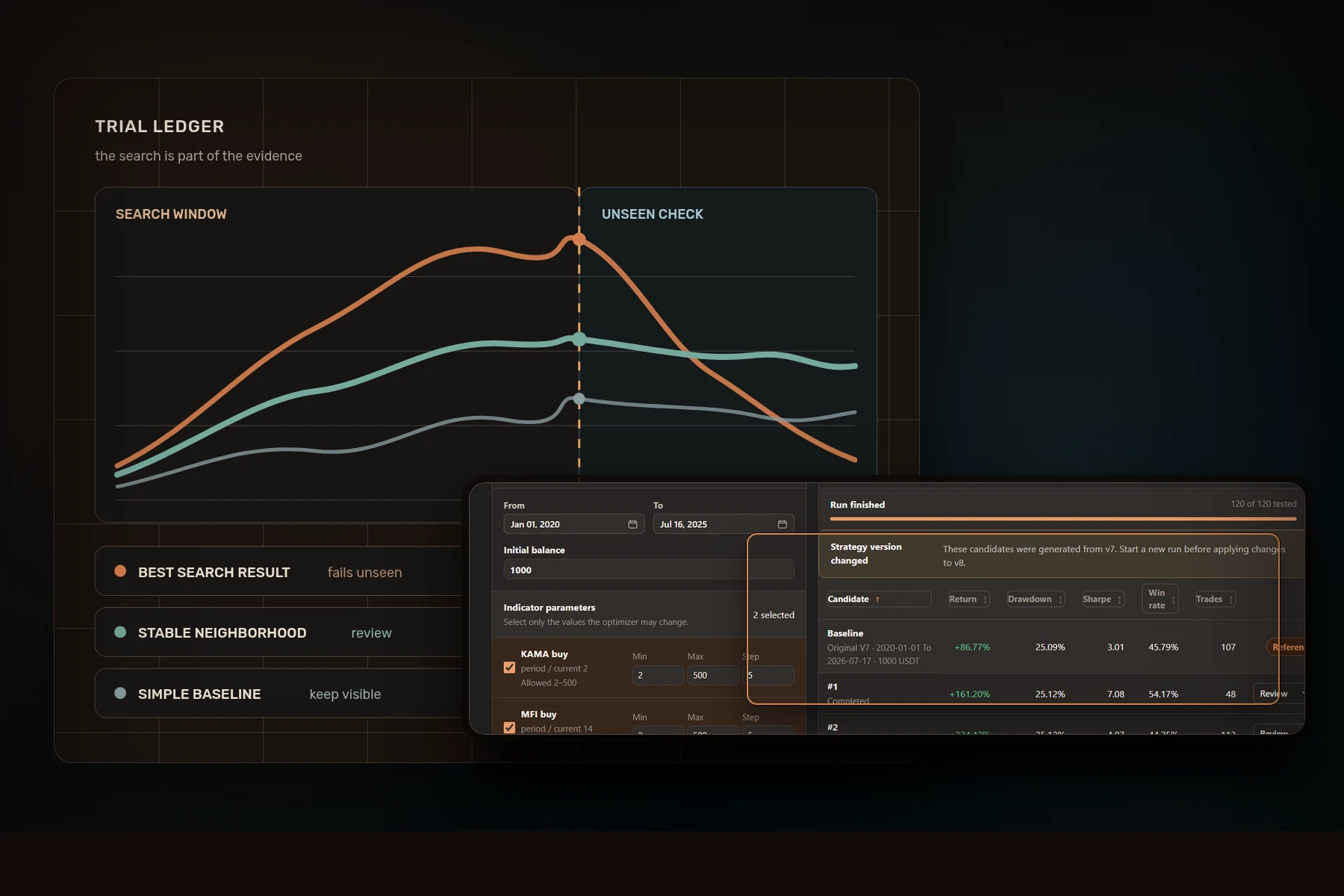
Crypto backtest overfitting happens when a strategy is tuned so closely to one historical sample that the strongest-looking result reflects repeated search rather than a durable rule. The practical defense is to write the hypothesis first, log every variation, cap parameter search, preserve an unseen period, and check whether nearby settings tell a similar story before choosing a candidate. A high historical curve alone is not evidence of future performance.
Why crypto backtest overfitting starts with the search
A backtest answers a narrow question: how would these exact rules have behaved under this dataset and these assumptions? The interpretation changes when you run many alternatives and keep only the best result.
Suppose two operators show the same historical chart. One tested a rule written before the run. The other tried 80 indicator combinations, timeframes, and exit settings before selecting the winner. The charts may look identical, but the second result survived a much larger search. That hidden trial count is part of the evidence.
Bailey, Borwein, López de Prado, and Zhu formalized this issue in their research on the probability of backtest overfitting. Their statistical framework is more advanced than the checklist here, but the practical lesson is accessible: selecting from repeated historical experiments creates a problem that the winning chart does not reveal by itself.
Write the test contract before the first run
A short test contract makes later judgment more honest. Record these six items before opening the results:
- Market question: What behavior is the strategy trying to describe?
- Rule: Which entry, exit, and risk conditions are fixed?
- Data boundary: Which dates belong to research, and which remain unseen?
- Cost assumptions: Which fees, slippage, and fill constraints are included?
- Trial budget: How many meaningful variations may be tested?
- Decision rule: What would make a candidate acceptable, inconclusive, or rejected?
Keep the data boundary visible. Gimmer’s public Running Backtest guide describes historical testing and warns that a favorable backtest does not mean the same outcome will occur in future conditions. The contract above is an external research record you keep beside the tool. It is not a claim that every field is built into Gimmer.
Use a trial ledger, not memory
A trial ledger reveals how much searching occurred before the apparent winner emerged. Here is an illustrative example:
| Trial and planned change | Research-window reading | Unseen-window reading and decision |
|---|---|---|
| 01: Written baseline | Moderate, consistent | Similar behavior; keep as reference |
| 02: One entry threshold | Small improvement | Similar behavior; retain for comparison |
| 03: Entry plus exit change | Best result | Sharp deterioration; reject |
| 04: Nearby entry threshold | Similar to trial 02 | Similar behavior; review stability |
The labels are deliberately qualitative. They are not Gimmer results, market data, or a recommendation. The important evidence is the sequence: what changed, when it changed, and whether unseen data was consulted before the candidate was locked.
Check the neighborhood, not only the peak
An isolated optimum deserves more skepticism than a broad, stable region. If a tiny change to an indicator period, threshold, or exit distance transforms the result, the strategy may depend on a historical accident.
Review at least three views:
- Nearby settings: Do small parameter changes produce broadly similar behavior?
- Unseen data: Does the locked candidate remain understandable when the reserved period is opened?
- Simple baseline: Does the extra complexity add a clear, repeatable benefit over the written baseline?
Gimmer’s current Strategy Optimizer presents a candidate-ranking surface for review. The optimizer candidate review guide explains why a ranking is a comparison, not permission to apply the first row automatically. Keep the trial count and the search boundaries beside that comparison.
Keep the unseen period unseen
An unseen period stops being unseen after you inspect it. If a candidate fails and you tune the rule around that failure, those dates have joined the research set. You need a new untouched period or a different validation design before making another independent check.
This is why a single train-test split is useful but not magical. Repeatedly checking the same holdout while adjusting the strategy can overfit the holdout too. For a practical starting point, read the out-of-sample testing checklist and record when each period was first opened.
Separate overfitting from other backtest errors
Several problems can make a historical result unreliable, but they are not interchangeable:
- Overfitting: repeated search selects rules tailored to the observed sample.
- Look-ahead bias: a decision uses information that would not have been available at that moment. Use the look-ahead-bias timeline to inspect that boundary.
- Data defects: gaps, duplicates, timestamp errors, or incomplete candles alter the input. Start with the crypto backtest data checklist.
- Cost or fill assumptions: fees, slippage, and order behavior are missing or unrealistic. The backtest fee checklist covers that separate review.
Passing one check does not clear the others. A strategy can avoid look-ahead bias and still be overfit. It can also be simple and still rely on incomplete data.
A practical candidate decision framework
Before selecting a candidate, answer these questions in order:
- Was the hypothesis written before the result was visible?
- Is every material trial recorded, including discarded ones?
- Did the search stay inside its planned budget?
- Are nearby settings reasonably stable?
- Was one period kept unseen until the candidate was locked?
- Were data, costs, and execution assumptions reviewed separately?
- Would you still understand the rule if the best metric were hidden?
If several answers are no, do not rescue the candidate with another unplanned tweak. Return to the hypothesis and start a new, bounded experiment.
Crypto backtest overfitting checklist
- Write one market question and one baseline rule.
- Choose the research and unseen periods before testing.
- Set a small, explicit trial budget.
- Change one meaningful assumption at a time when practical.
- Log every trial, not only the survivors.
- Compare nearby parameters and a simpler baseline.
- Open unseen data only after the candidate is locked.
- Do not tune on the same unseen period after inspecting it.
- Review data quality, fees, slippage, and fill assumptions separately.
- Treat the final result as historical evidence, never a forecast or promise.
Frequently asked questions
What is crypto backtest overfitting?
It is the selection of a strategy that fits the tested historical sample unusually well after repeated rule or parameter search, without enough evidence that the behavior is stable outside that search.
Does more historical data prevent overfitting?
No. More relevant, accurate data can help, but overfitting can still occur when the search is large, the trial history is hidden, or the same validation data is reused.
Is one out-of-sample test enough?
It is a useful control, not a guarantee. Once you inspect and tune against that period, it is no longer an independent unseen check. The number of trials and the full validation design still matter.
Make the experiment visible
A backtest becomes easier to evaluate when the process around it is visible. The hypothesis, trial budget, discarded candidates, parameter neighborhood, unseen-data boundary, and execution assumptions belong beside the winning chart.
For your next step, open Gimmer’s Running Backtest guide, write the rule and trial budget before the first run, and keep one period unseen until the candidate is locked. Historical evidence can improve a decision process, but it cannot guarantee a future trading outcome.
Pingback: Crypto Backtest Survivorship Bias: Rebuild the Point-in-Time Universe – Gimmer – Automated Crypto-Trading
Pingback: Crypto Backtest Sample Size: Count Decisions, Not Just Trades – Gimmer – Automated Crypto-Trading