
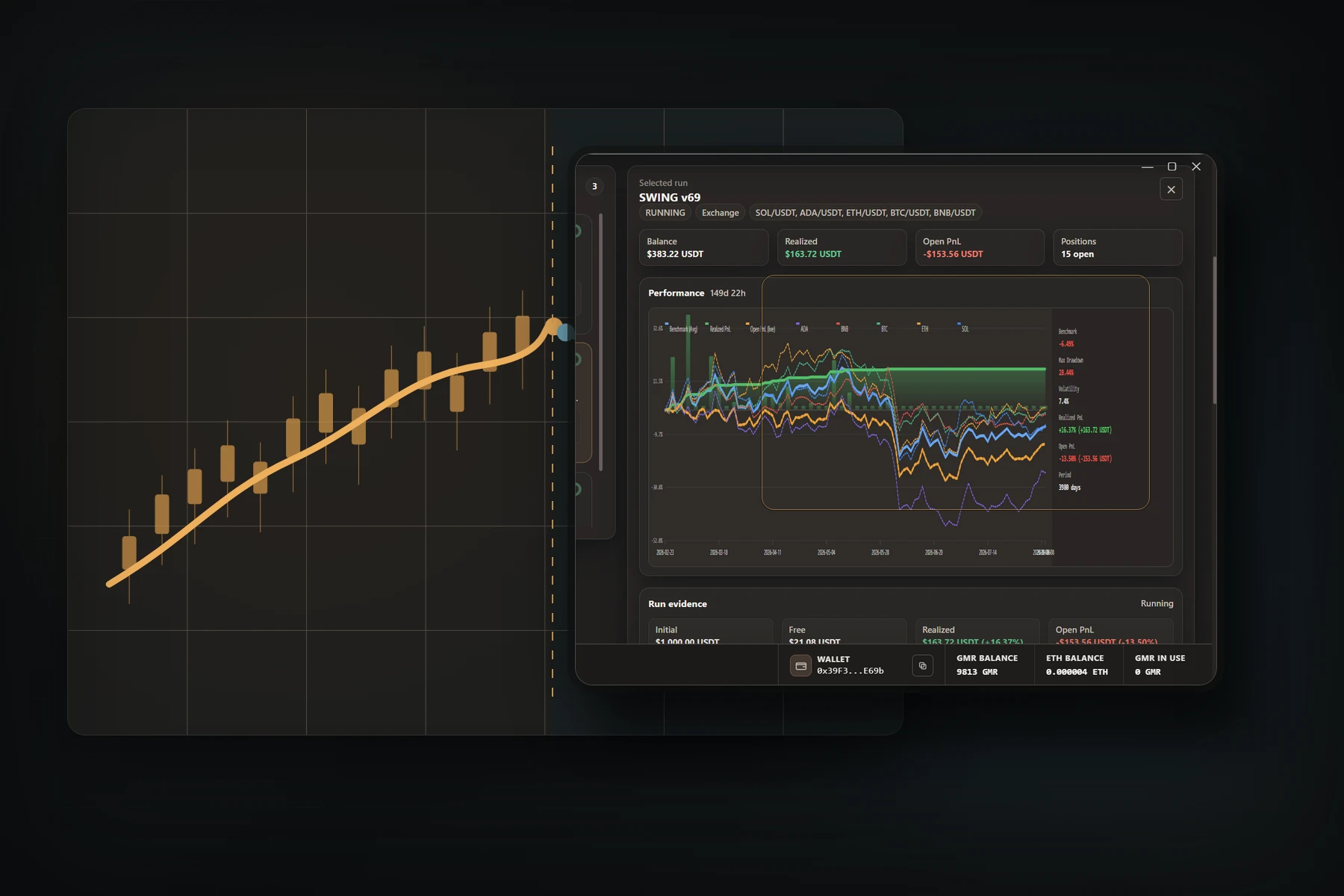
Crypto strategy backtesting is more useful when historical data has two different jobs. Use an earlier period to design and select the strategy. Keep a later period unseen, lock the chosen revision, then test it on that held-back range. This does not prove that a crypto trading strategy will work in the future. It gives you a cleaner question: did the rules survive data that did not influence them?
If you keep changing parameters after reading the later period, it is no longer out of sample. It has become part of the development data.
Why crypto strategy backtesting needs two data roles
A backtest can answer what a fixed set of rules would have done on a specific historical sample. It cannot turn that sample into a forecast.
The risk grows when you try many indicators, thresholds, markets, timeframes, and exits on the same candles, then keep only the strongest result. The selected version may describe noise in that particular sample instead of a repeatable rule. Bailey, Ger, Lopez de Prado, Sim, and Wu describe this selection problem in their Lawrence Berkeley National Laboratory paper on statistical overfitting and backtest performance.
Separating the data creates a useful boundary:
- In-sample period: the earlier history you may use to form the rule, compare parameters, and choose a revision.
- Out-of-sample period: later history that stays hidden from parameter selection until the revision is locked.
The split does not remove selection bias, data errors, or market risk. It makes one source of self-deception easier to see.
A practical 24-month example
Imagine that you have 24 months of suitable historical candles. Before tuning anything, write down this illustrative plan:
- Use months 1 through 18 for research and parameter selection.
- Keep months 19 through 24 unseen.
- Record the strategy revision, markets, timeframe, initial balance, sizing, fees, slippage assumption, and risk settings.
- Lock that revision before opening the final six months.
The 18/6 split is an example, not a universal ratio. A useful holdout needs enough relevant market behavior and enough trades to challenge the strategy. A quiet six-month period with two trades may tell you less than a shorter but more representative period. Choose the boundary before you know which split makes the chart look best.
A five-step crypto strategy backtesting workflow
1. Define the chronological boundary first
Market data is ordered in time, so keep the validation period later than the development period. Do not randomly mix future candles into the data used to choose earlier rules. Record the dates and keep them stable while you compare candidates.
2. Use the earlier period to ask a bounded question
Change one explainable part of the strategy at a time. You might compare a small indicator range, a position-sizing rule, or a stop condition. Keep the baseline visible and count how many variations you tried. The more variations you inspect on one sample, the easier it is to select a lucky historical fit.
Gimmer’s public Strategy Optimizer guide follows the same review principle: compare the baseline with candidates, inspect drawdown and trade count, and treat a ranked result as historical evidence rather than a forecast.
3. Lock the chosen revision
Save the exact rules before looking at the held-back range. Record the engine, execution mode, markets, interval, sizing, leverage when relevant, and risk controls. Also record cost assumptions. A result is difficult to compare when the strategy, data, or accounting rules move at the same time.
4. Run the unseen period without retuning
Test the locked revision on the later range. Wait for a final state, then read the report as a system. The Gimmer Running Backtest guide recommends comparing realized and open PnL, max drawdown, win rate, trade count, and benchmark context rather than reducing a run to one number.
If the later result disappoints you, do not adjust the parameters against that same range and continue calling it unseen. Return to research, document what changed, and reserve a new later period for the next honest validation.
5. Stress the conclusion, not only the parameters
Rerun the locked strategy with worse costs where the tool and data support it. Review nearby parameter values. Look for dependence on one asset, one short event, or very few trades. Then use the risk-controls guide to keep sizing, exits, drawdown, and open exposure in the decision.
A strategy that survives one holdout can still fail later. The next decision is whether the evidence justifies more testing, not whether the strategy has been certified.
What to compare when the unseen result changes
| Observation | Question to ask |
|---|---|
| Return falls sharply | Did the original result depend on one trend, asset, or parameter peak? |
| Drawdown expands | Did the later market expose longer open losses or weaker exit behavior? |
| Trade count collapses | Was the rule active only in a narrow historical regime? |
| Costs change the result | Were fees, spread, slippage, funding, or borrowing understated? |
| One market carries the result | Does the strategy have evidence beyond one asset or isolated event? |
| Nearby parameters fail | Was the selected setting one fragile historical peak? |
These questions do not create universal pass marks. They help you explain why two periods differ. For a careful reading order inside one report, use the Gimmer article on reading backtest results without turning a chart into a promise.
Do not recycle validation data by accident
Suppose the locked revision fails months 19 through 24. You change a threshold, rerun those months, change it again, and stop when the result improves. That final period now influenced selection. It is research data, even if your spreadsheet still labels it out of sample.
Keep a simple experiment log:
- Record every tested revision and date range.
- Mark which data influenced the strategy choice.
- Freeze the next validation boundary before inspecting the result.
- Preserve failed runs instead of reporting only the winner.
This log is often more useful than another decimal place in a score. It shows how much searching happened before the selected result appeared.
When a walk-forward version helps
One fixed holdout gives you one comparison. A walk-forward process repeats the sequence through time: select on an earlier window, lock the rules, test on the next window, then move both windows forward. Each later test must remain unseen until its turn.
This can reveal whether behavior changes across different market regimes, but it also creates more experiments to track. Do not describe a manual series of windows as an automatic Gimmer feature. The method is a research discipline that you can apply with tools that let you control historical ranges and preserve revisions.
Where simulation fits after out-of-sample testing
Historical validation and simulation answer different questions. Out-of-sample testing challenges a strategy against later candles that did not influence selection. Simulation helps you observe current operational behavior without committing real funds. It can expose state, data, timing, and workflow problems that historical candles do not reproduce.
Use Gimmer’s simulation and live-operation guide to keep that next stage explicit. Neither a backtest nor a simulation guarantees future execution, fills, availability, or results.
Frequently asked questions
What percentage of data should be out of sample?
There is no universal percentage. The later period needs enough observations, trades, and relevant market behavior to challenge the strategy. Choose it before tuning, document the reason, and avoid selecting the split that produces the most attractive result.
Does one strong out-of-sample backtest prove that a strategy works?
No. It is evidence from one later historical period. Data quality, costs, regime changes, execution behavior, outages, partial fills, liquidity, and future market conditions can still differ.
Can I tune the strategy after an out-of-sample failure?
Yes, but the failed period has now informed the next revision. Treat it as research data and reserve a new unseen period before making another out-of-sample claim.
Conclusion
Crypto strategy backtesting becomes more honest when selection and validation have separate data. Choose the chronological split first, tune only on the earlier range, lock the revision, and let the later range challenge it. If you retune after seeing the holdout, rename it research and start a fresh validation cycle.
Next step: Open the Gimmer Running Backtest guide, write down one chronological split before changing parameters, and keep the later range unseen until the strategy revision is locked.
The Gimmer Team