
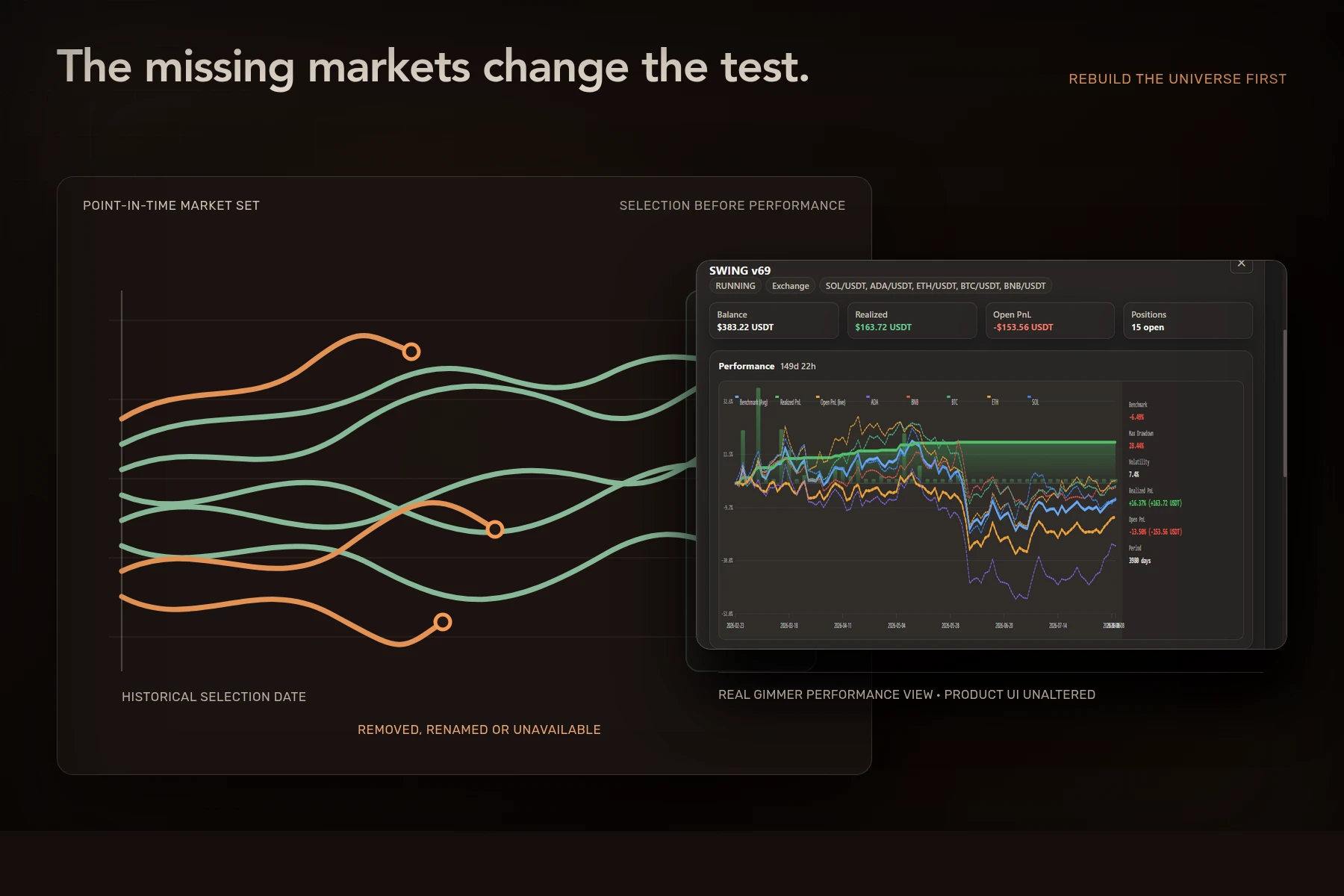
Crypto backtest survivorship bias appears when you test only the assets that are still visible today. A token that was delisted, renamed, abandoned, or no longer meets your liquidity rule can disappear from the sample, even though it belonged to the historical opportunity set. The result may look cleaner because the market universe already knows which assets survived. Fix the selection record before you inspect returns.
What survivorship bias means in a crypto backtest
A historical test has at least two models. The obvious one is the trading logic: entries, exits, position size, costs, and risk controls. The earlier model is asset selection: which markets were eligible on each date.
Survivorship bias enters when today’s listings decide yesterday’s test universe. Common paths include:
- starting with a current list of high-volume assets and replaying it backward;
- dropping a market because its later history is incomplete;
- merging a renamed asset into one continuous series without recording the boundary;
- removing a delisted market without preserving its last eligible date; or
- requiring data fields that only today’s surviving markets provide.
A University of St. Gallen and University of Liechtenstein research paper on survivorship and delisting bias in cryptocurrency markets found that survival-conditioned samples can materially distort performance measures and factor conclusions. The paper does not describe Gimmer, and its estimates are not a shortcut for your dataset. It supports the narrower point that omitted non-survivors can change what a historical crypto sample appears to show.
Crypto backtest survivorship bias begins before the first candle
Suppose you want to test a rule across markets that met a minimum trading-history requirement on January 1. If you build the list from today’s exchange directory, you have already used future information. Every asset in the list is known to have remained visible until the date you assembled it.
The bias can matter even in a single-pair test. If you chose that pair because it is liquid, familiar, and available today, then projected it into an earlier period, the selection decision still used its later survival. This does not make the backtest useless. It changes the claim from “this rule worked across the historical opportunity set” to “this rule behaved this way on a market selected with today’s knowledge.”
Compare survivor-only and point-in-time universes
| Decision | Survivor-only test | Point-in-time test |
|---|---|---|
| Universe date | Built from the current market list | Reconstructed for each historical selection date |
| Eligibility | Applied to today’s survivors | Applied using information available at that date |
| Removed markets | Often absent without a record | Kept through the last eligible observation |
| Missing data | Asset may be dropped automatically | Gap, listing start, rename, or removal is classified |
| Interpretation | Conditional on later survival | Closer to the historical opportunity set |
Point-in-time does not mean perfect. Historical listing records, symbol changes, corporate actions, chain migrations, and reliable candle archives may be incomplete. The aim is to make those limits visible rather than letting the current market list silently define the past.
An eight-market selection example
Imagine that your written rule identifies eight eligible markets at the start of a test. By the final date, five remain listed under the same symbols, one was renamed, one was removed from the venue, and one has an unresolved data gap.
A survivor-only workflow starts with the five clean series. A point-in-time workflow starts with all eight records, then documents what happened:
- Keep the renamed market only if the identity and conversion boundary can be verified.
- Keep the removed market through its last eligible timestamp and state how any open position is handled.
- Pause or limit the conclusion for the unresolved gap instead of silently deleting the market.
- Run a survivor-only sensitivity check separately, with a label that says it uses later survival knowledge.
This example contains no returns. It shows why the selection log comes before the performance table. If three records disappear before testing begins, no metric can reveal that omission later.
Build a point-in-time universe record
1. Freeze the selection timestamp
Write the date and timezone at which a market becomes eligible. For a periodically refreshed universe, record every rebalance date rather than using one current list for the whole period.
2. Name the venue and market identity
Record the exchange, base asset, quote asset, symbol at the time, listing start, and known removal or rename date. Do not assume the same ticker always identifies the same asset or contract.
3. Apply rules with only contemporaneous data
Liquidity, trading history, price, or other filters should use information that would have existed at the selection timestamp. A later ranking, current market capitalization, or present-day volume reintroduces future knowledge.
4. Classify every exclusion
Separate “not eligible then” from “data unavailable now.” Keep a reason code for listing start, delisting, rename, data gap, unsupported interval, or failed identity match. An undocumented exclusion is part of the result even if it never appears in the chart.
5. Lock the universe before strategy settings
Freeze the eligible set and its evidence before tuning indicators or risk controls. Otherwise an uncomfortable market can be removed after you see its effect, turning selection into another hidden trial. The crypto backtest overfitting checklist explains why every trial, including selection changes, belongs in the experiment log.
Keep universe quality separate from candle quality
A complete market list can still contain poor data, and a perfect candle series can still come from a survivor-biased universe. Review both layers.
First ask whether the correct markets are present. Then inspect timestamps, duplicates, missing intervals, unfinished candles, and price adjustments for each included market. Use the crypto backtest candle-data checklist for the second layer.
If a market lacks trustworthy data, do not fill the gap merely to preserve the sample. State the treatment, test how the exclusion changes the result when possible, and narrow the conclusion when reconstruction remains incomplete.
Where Gimmer fits in the workflow
Gimmer’s public Running Backtest guide covers the historical test step for a chosen exchange, pair, period, and strategy settings. That workflow helps you test a defined market and inspect the resulting graph and records.
It does not establish that today’s public Gimmer workflow reconstructs a point-in-time cryptocurrency universe or repairs delisted data. Universe construction is a separate research step. Freeze the selection record first, then use the historical test to answer the narrower question supported by that market and date range.
After the first run, keep the strategy revision locked when you move to later dates. The guide to out-of-sample crypto backtesting shows how to separate development dates from unseen validation dates. If you add a comparison series, use the crypto backtest benchmark framework to align its market universe, dates, costs, capital, and risk treatment.
Frequently asked questions
Does survivorship bias matter if I test only one crypto pair?
It can. If the pair was selected because it still exists, remains liquid, or looks important today, that choice used information unavailable at the start of the historical period. State the selection basis and limit the conclusion accordingly.
Should every delisted asset be treated as a total loss?
No. Removal, rename, migration, and data loss are different events. Use verified market history and an explicit open-position rule. Do not assign a zero value or a successful exit without evidence.
Can I delete a market with missing candles?
You can exclude it only with a recorded reason and a clear interpretation limit. First determine whether the gap reflects a listing boundary, venue outage, archive failure, interval mismatch, or another cause. When possible, compare the result with and without the exclusion.
Make the missing markets visible
Crypto backtest survivorship bias is a selection problem before it becomes a performance problem. Freeze the historical universe, preserve removed markets and exclusion reasons, then read the strategy result inside that documented boundary.
For your next test, open Gimmer’s Running Backtest guide, write the point-in-time universe and every exclusion in one selection record, and start the historical run only after that record is locked.