
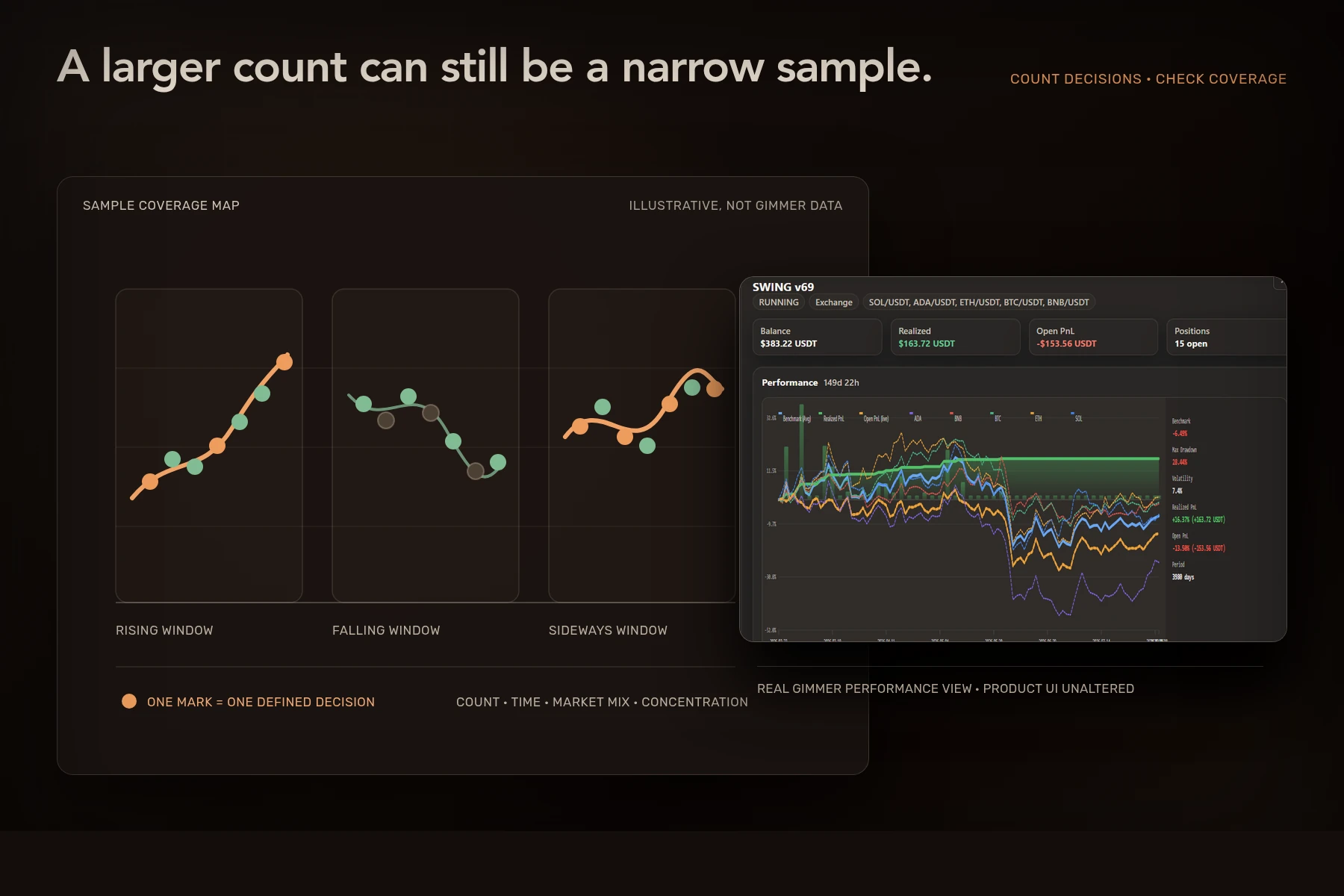
There is no universal minimum crypto backtest sample size that makes a strategy result reliable. Start by defining what one observation means, then check how many distinct strategy decisions the run contains, which market conditions it covers, and whether one pair, direction, or short period dominates the sample. A large raw trade count can still describe a narrow slice of history.
What crypto backtest sample size means
Sample size is the number of observations behind a conclusion. In a crypto backtest, the observation might be a closed position, an entry decision, a daily return, or another consistently defined unit. Those units are not interchangeable.
A report can contain many order records without containing the same number of independent strategy decisions. One position may generate an entry, several partial fills, an adjustment, and an exit. Counting every record as a separate observation can make the evidence look broader than the strategy logic actually was.
The general statistical principle is not to pick a count in isolation. The NIST sample-size guidance connects sample planning to the precision required and the variability expected. A strategy review has additional complications, including time dependence and changing market conditions. That is why a single minimum number cannot settle the question.
Why more trades do not automatically mean broader evidence
Imagine a strategy that trades repeatedly during one strong trend on one market. It may produce more records than a slower strategy tested across several rising, falling, and sideways periods. The first count is larger, but its conditions may be more concentrated.
This does not make the second test better by default. It means the counts answer different questions. Before comparing the results, expose the sample boundary behind each one.
Count decisions before fills
Choose one analysis unit and use it consistently. For many strategy reviews, a completed position or entry decision is easier to interpret than a raw execution record. Whatever unit you choose, write down how these cases are handled:
- partial fills belonging to one order;
- scale-in or scale-out actions within one position;
- entry and exit records from the same trade;
- rejected, cancelled, or unfilled orders;
- positions still open when the historical period ends.
The goal is not to force every strategy into one definition. The goal is to prevent the definition from changing between candidates.
Cover time and market regimes
Trade count says little about when the observations occurred. A sample concentrated in ten volatile days is different from one spread across several months. Record the start and end dates, active days, candle interval, and any long gaps with no decisions.
Gimmer’s public Running Backtest guide asks the operator to choose a meaningful date range that includes rising, falling, sideways, high-volatility, and low-volatility periods where data exists. This is a coverage checklist, not a claim that history contains every future condition.
Keep the conditions visible even when the strategy trades rarely in some of them. Zero decisions during a period can be relevant evidence about the rules, but it should not be silently counted as additional trades.
Measure concentration before reading the headline result
A sample can span a long period and still depend heavily on one cluster. Group the observations by dimensions that match the strategy:
- market or pair;
- long, short, or other operation type;
- rising, falling, or sideways period;
- high- or low-volatility period;
- month, week, or trading session;
- parameter revision.
Then record the largest bucket as a share of the defined observations. A concentrated sample is not automatically invalid. It simply supports a narrower statement than a balanced one.
Two illustrative samples with different boundaries
Consider two invented run records. The figures below are not Gimmer results, market data, or recommendations. They show why the raw record count needs context.
| Sample field | Run A | Run B |
|---|---|---|
| Raw execution records | 120 | 86 |
| Defined decision units | 24 completed positions | 72 completed positions |
| Historical span | 18 days | 210 days |
| Market coverage | One pair | Three pairs |
| Largest condition bucket | 83% of decisions | 39% of decisions |
Run A has more execution records, but far fewer defined decision units and a more concentrated history. Run B has broader coverage, but that does not prove its strategy is robust or suitable for live use. Data quality, costs, risk, trial selection, and unseen validation still matter.
Use a sample-adequacy checklist
- Define the observation. State whether the count represents fills, orders, entries, completed positions, daily returns, or another unit.
- Reconcile the ledger. Explain partial fills, open positions, cancellations, and duplicate records.
- Record the time boundary. Include start and end dates, active days, interval, and gaps.
- Map the coverage. Name markets, directions, and market conditions represented.
- Measure concentration. Record the largest relevant bucket and the rule used to form it.
- Check the inputs. Use the crypto backtest data checklist before treating any count as valid.
- Preserve the search history. Use an overfitting trial log so the selected run is not separated from discarded variations.
- Keep an unseen period. Apply the out-of-sample testing workflow after the strategy revision is locked.
When the sample needs more evidence
Collect or preserve more history when the result depends on very few defined decisions, one short period, one market, or one condition bucket. Also pause when a small change in dates or parameters materially changes the headline result.
More history is not a cure for poor data or repeated strategy selection. A longer test can repeat the same bias at a larger scale. Review the return interval and calculation boundary with the Sharpe ratio input checklist when a summary metric depends on the sample.
Frequently asked questions
How many trades are enough for a crypto backtest?
There is no universal number. The answer depends on what counts as one observation, how variable the results are, how concentrated the decisions are, which conditions are covered, and what conclusion you want to draw.
Does a larger trade count make a backtest reliable?
No. A larger count can still come from partial fills, closely related decisions, one market, or one short regime. It is useful only after the counting rule and coverage are explicit.
Can I combine trades from several crypto markets?
You can review them together only when the strategy rules and counting method are comparable. Keep the market-level groups visible so one pair does not hide the behavior of the others.
Record the boundary before comparing results
A crypto backtest sample size becomes useful when another reviewer can reconstruct what was counted and where the evidence came from. The raw total alone cannot provide that context.
For the next historical run, open Gimmer’s Running Backtest guide and record the observation unit, distinct decision count, date range, market conditions, markets, and largest concentration beside the report. Compare results only after those boundaries are visible, and treat every backtest as evidence about tested history rather than a promise about future trading.