
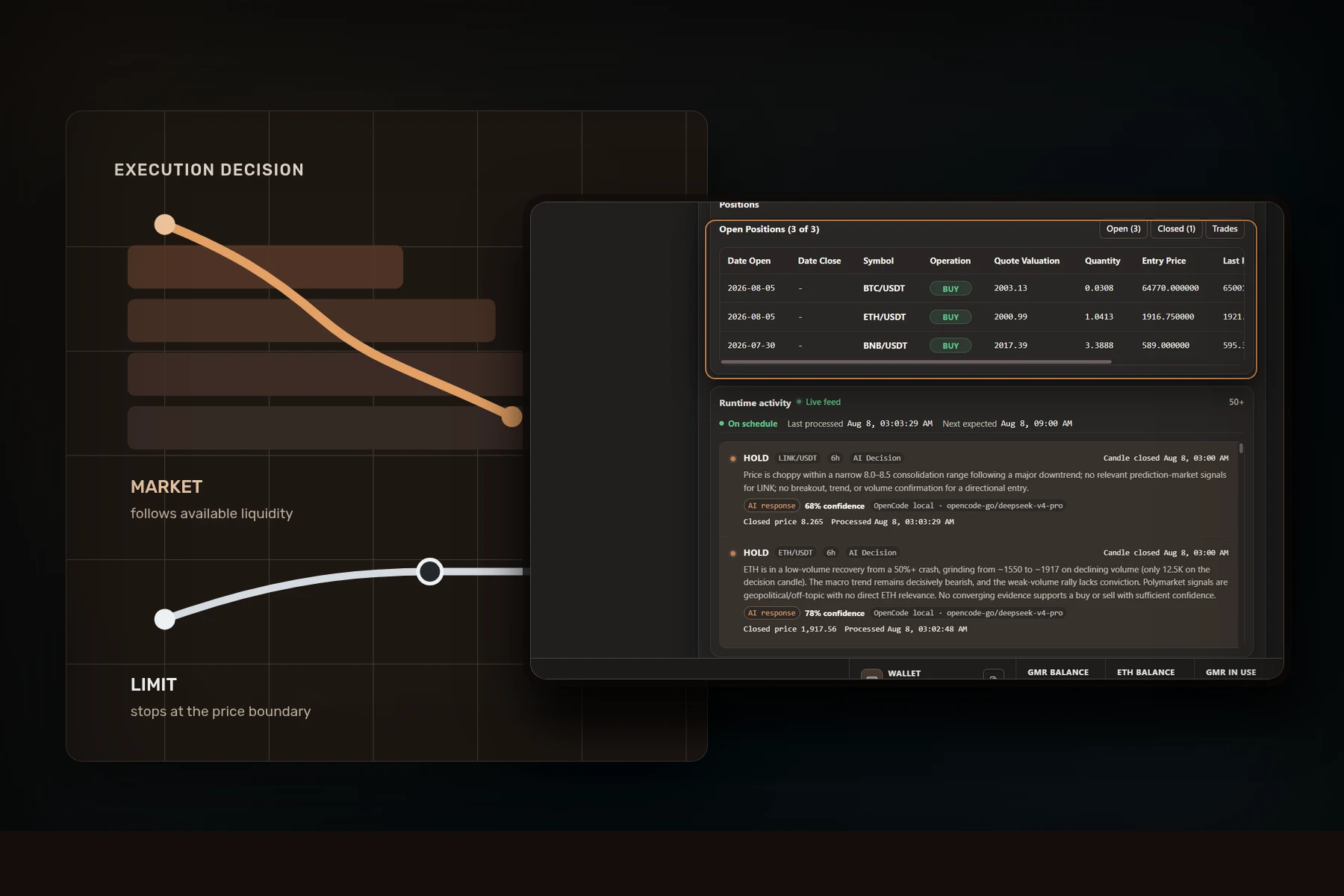
Crypto trading bot order types define what an automated instruction prioritizes. A market order seeks immediate execution against available liquidity, so the final price can differ from the quote the bot observed. A limit order sets the worst acceptable price, but it may fill only partly or not at all. The right choice depends on liquidity, urgency, size, and what the bot should do when execution remains incomplete.
The useful distinction is not “fast versus safe.” It is execution priority versus price boundary. Both choices need a documented size, time-in-force, partial-fill rule, timeout policy, and final-state check.
Crypto trading bot order types in one table
| Question | Market order | Limit order |
|---|---|---|
| What does it prioritize? | Execution against available liquidity | A stated price boundary |
| Is the displayed price guaranteed? | No | The boundary applies, but execution is not guaranteed |
| Can it fill at several prices? | Yes, when size consumes multiple order-book levels | Yes, at prices within the limit |
| Can it remain unfilled? | Venue checks, liquidity, outages, or rejection can still prevent completion | Yes, when the market does not reach the limit or available size is insufficient |
| What needs monitoring? | Average fill price, filled size, fees, and final state | Open size, partial fills, expiry or cancellation, and final state |
A marketable limit order can execute immediately if its boundary crosses available liquidity. A passive limit order can rest in the book. That is why the label alone is not enough. Price, size, side, time-in-force, and current market depth define what the instruction can actually do.
How a market order behaves
A market order tells the venue to execute against available offers for a buy or bids for a sell. It does not reserve the price visible when the signal was calculated. Between the decision and the fill, the book can change. A larger instruction can also consume more than one level.
This creates an important automation boundary: urgency does not remove price uncertainty. Spread, depth, volatility, latency, minimum size, precision, account permissions, and venue state can all affect the result. The guide to reading a trading-pair page as market context explains why a visible quote is evidence about a moment, not a promise about the next execution.
Use a market order only when the strategy can tolerate the difference between the observed quote and the final average fill. Define that tolerance before the signal appears, not after an unfavorable execution.
How a limit order behaves
A limit order adds a price boundary. A buy limit should not execute above its limit, and a sell limit should not execute below its limit. That protects the stated boundary, but it does not guarantee that the order will trade.
The market can move away, reach the level without enough available size, or fill only part of the order before the instruction expires or is canceled. A bot therefore needs a policy for the remaining quantity. Waiting, canceling, repricing, or switching order type are different strategy decisions with different costs and risks.
Venue parameters matter. Coinbase’s official Create Order documentation exposes separate market and limit configurations, including limit price and time-bound variants. Kraken’s official Add Order documentation lists order type and time-in-force as distinct parameters. These sources describe their own APIs. They do not establish current Gimmer venue support or a universal contract for every market.
A practical market-versus-limit example
Consider an illustrative buy instruction for 1.0 unit. The visible offers are:
- 0.3 units at 100.00
- 0.4 units at 100.20
- 0.5 units at 100.60
A market order for 1.0 unit could consume all of the first two levels and 0.3 units of the third. Before fees, its weighted average fill would be 100.26. The final result can still differ if the book changes while the order is processed.
A buy limit for 1.0 unit at 100.20 would cap execution at that price. With only the displayed liquidity, it could fill 0.7 units and leave 0.3 units open. Whether the remainder waits, expires, or is canceled depends on the time-in-force and the bot’s follow-up rule.
These numbers are arithmetic for comparison, not Gimmer data, venue data, a forecast, or a recommendation. The lesson is operational: market orders can trade through several prices, while limit orders can leave unfinished state.
Time-in-force and partial fills belong in the strategy
“Limit order” is incomplete without a lifetime. Good-till-canceled, immediate-or-cancel, fill-or-kill, and time-bounded instructions behave differently, and venues do not always name or implement them identically.
Before automation, record:
- Side and size. Define the asset quantity or quote amount and how rounding is handled.
- Order type and price boundary. State whether execution or price has priority.
- Time-in-force. Decide how long the instruction may remain active.
- Partial-fill rule. Decide whether the strategy accepts, cancels, or reassesses the remainder.
- Timeout and retry rule. A timeout is an unknown state until external status is reconciled.
- Final-state evidence. Preserve the order identifier, filled size, average price, fees, and terminal status.
Gimmer’s Connect an Exchange guide identifies several checks that can affect execution, including balance, permissions, minimum quantity, notional value, precision, fees, rate limits, and venue availability. Passing a strategy signal does not bypass those constraints.
Submitted is not the same as filled
An automation system should treat order intent, venue acknowledgement, partial fill, final fill, cancellation, expiry, and rejection as different states. A successful request only proves that one stage completed.
Gimmer’s Simulation and Live guide tells operators to review operation, amount, price, PnL, and final execution status, and to monitor the first order attempt through a final state. It also warns that a network timeout does not prove failure. Reconcile the exchange or wallet state before retrying so a delayed confirmation does not create a duplicate position.
Simulation can expose state handling without intentionally submitting real-money orders. The guide to using simulation first in Gimmer’s Trading Workspace shows how to keep observation separate from a live-funds decision.
Keep execution costs separate from the order label
Market does not always mean expensive, and limit does not always mean cheap. Fees can depend on maker or taker role, venue, market, account tier, and whether the order executes immediately. Opportunity cost also matters when a passive order never fills.
Use the crypto trading bot fee checklist to document fees, spread, slippage, and cost sensitivity. Keep that cost model separate from the order-state policy so you can tell whether a result changed because of execution price, fee assumptions, or an unfinished order.
Crypto trading bot order types FAQ
Is a limit order always safer than a market order?
No. A limit order controls the price boundary, but it introduces non-execution and partial-fill risk. A market order prioritizes execution, but the final price is uncertain. The relevant risk depends on the strategy, size, liquidity, urgency, and follow-up behavior.
Can a market order fail?
Yes. Insufficient balance, permissions, minimum-size rules, precision, venue outages, validation errors, or missing liquidity can prevent or fragment execution. Treat the final venue state as evidence.
What should a bot do after a partial fill?
That rule must be explicit before trading. The bot might accept the filled amount, cancel the remainder, wait, or reassess. Blindly resubmitting can duplicate exposure when the first order is still open or a delayed fill arrives.
Conclusion
Crypto trading bot order types are execution instructions, not outcome guarantees. Market orders prioritize immediate execution and accept price uncertainty. Limit orders enforce a price boundary and accept fill uncertainty. Both need a documented lifetime, partial-fill policy, retry boundary, and final-state check.
Next step: open Gimmer’s Simulation and Live guide, then write down the order instruction, price boundary, time-in-force, partial-fill rule, and final-state check before the next controlled simulation.
The Gimmer Team
Pingback: Crypto Trading Bot Take Profit: Targets, Size, and Fill Checks – Gimmer – Automated Crypto-Trading
Pingback: Crypto Portfolio Rebalancing After a Balance-Data Delay – Gimmer – Automated Crypto-Trading