
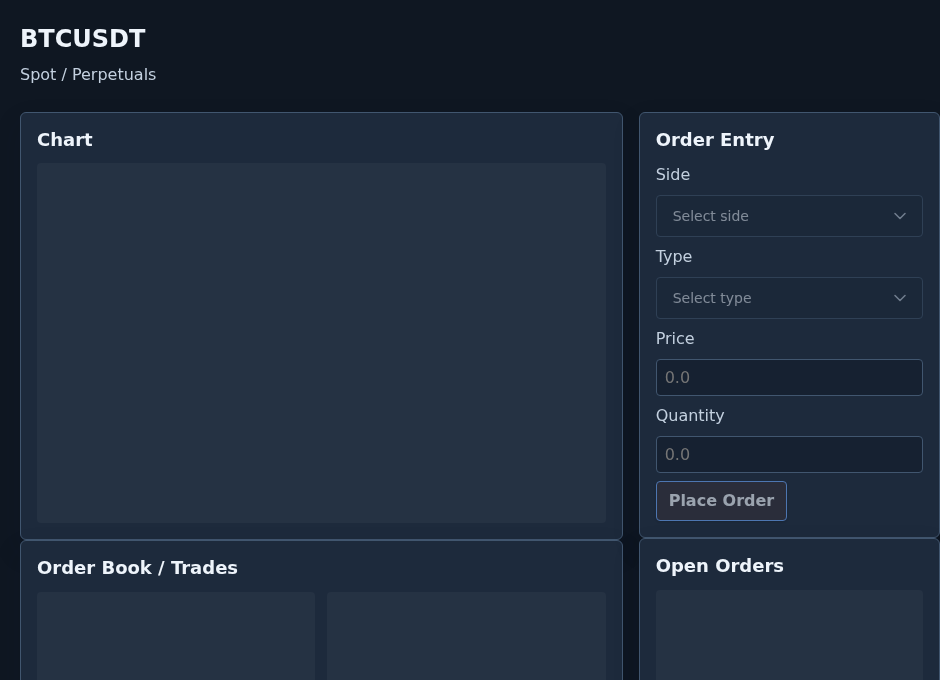
A symbol-specific trading page can feel more actionable than it really is. When a route already gives you a market name, a chart, and panels labeled Order Entry, Open Orders, or Positions, it is easy to read the page as a shortcut to a decision. Gimmer’s current pair page is more trustworthy when you read it another way: first as orientation. Confirm the symbol, read the chart as context, and pay attention to which parts of the page are visibly inactive before you assume the route is telling you to do anything next.
Start With The Symbol, Not With A Conclusion
The first useful question on a pair page is simple: what market are you actually looking at?
The current route makes the symbol the page title and pairs it with the subtitle Spot / Perpetuals. That matters because a market page is only helpful if you first confirm that you opened the symbol you meant to inspect.
This sounds obvious, but it is also where discipline starts. A page can feel familiar long before it is specific. The symbol header is the checkpoint that keeps the rest of the page grounded in the market you intended to read.
Use The Chart As Context, Not As A Signal
The current page gives the chart the most visual weight, and that makes sense. A chart is often the quickest way to understand what market you are looking at.
What it should not become is a shortcut to a promise. A visible chart can help you orient around a pair, but it does not remove the need to verify what the rest of the route is actually offering. A chart is context. It is not advice.
The safer habit is to let the chart answer one question at a time: does this still look like the market I meant to inspect? If the answer is yes, then the next step is not a trade. The next step is reading the rest of the page honestly.
Read Placeholder Panels As Boundaries
The route also includes an Order Book / Trades card plus separate cards for Open Orders and Positions.
Those headings matter because they tell you what kind of information belongs on a deeper trading surface. But on the current pair page, those panels are still placeholders. That is useful context in its own right. A page can teach you its limits if you are willing to notice them.
Instead of reading empty or placeholder sections as missing secret insight, read them as a boundary. The route is showing you the shape of a market page without pretending that every decision surface is already active here.
Let Disabled Controls Slow You Down
The clearest trust signal on the current page may be the one that does not let you act.
The Order Entry card shows familiar fields such as Side, Type, Price, and Quantity, along with a visible Place Order button. But the controls are disabled. That is not just a styling detail. It is a statement about what this route currently does and does not let you do.
Disabled controls can be clarifying. They remind you that a market page and an execution workflow are not always the same thing. If the route is not inviting action yet, the right response is not impatience. It is better interpretation.
Why This Matters For Trust
Trading interfaces become risky when the visuals imply more certainty than the workflow actually supports.
A symbol page with a chart and execution-shaped panels can create momentum in the reader’s head. That is exactly why a conservative reading order matters. Confirm the market, read the chart as context, notice the placeholder sections, and respect the disabled controls. The page becomes more trustworthy when you let its current boundaries speak clearly.
This is also what keeps public product language honest. A page that helps you orient around a market is valuable. It does not need to pretend it is giving you a recommendation to be useful.
What This Page Does Not Prove
The current pair page does not tell you what trade to place. It does not turn chart movement into a recommendation. And it does not suggest that visible execution fields are already actionable on this route.
What it does provide is smaller, but still useful: a symbol-specific page that helps you confirm what market you are reading and whether this route is the right place to keep going.
A Practical Reading Routine For The Pair Page
A conservative routine on the current pair page looks like this:
- Confirm the symbol in the page title before you interpret anything else.
- Read Spot / Perpetuals as route context, not as a prompt to act.
- Use the Chart card to orient yourself around the market rather than to skip ahead to a decision.
- Notice that Order Book / Trades, Open Orders, and Positions are currently placeholder surfaces on this route.
- Treat the disabled Order Entry controls as a visible boundary, not as an invitation to force a workflow onto the page.
- Move to a broader trading flow only after the market context still matches what you actually need.
Final Thoughts
Not every trading page needs to tell you what to do next. Some of the most trustworthy pages simply tell you where you are, what you are looking at, and what is not ready on that route.
That is the value of Gimmer’s current pair page. It can help you orient around a symbol without pretending that orientation is the same thing as advice.
Open a trading pair page, confirm the symbol you are reading, use the chart as context, notice which panels are informational versus inactive, and move to the broader trading workspace only after the same market view still matches what you need.
— The Gimmer Team