
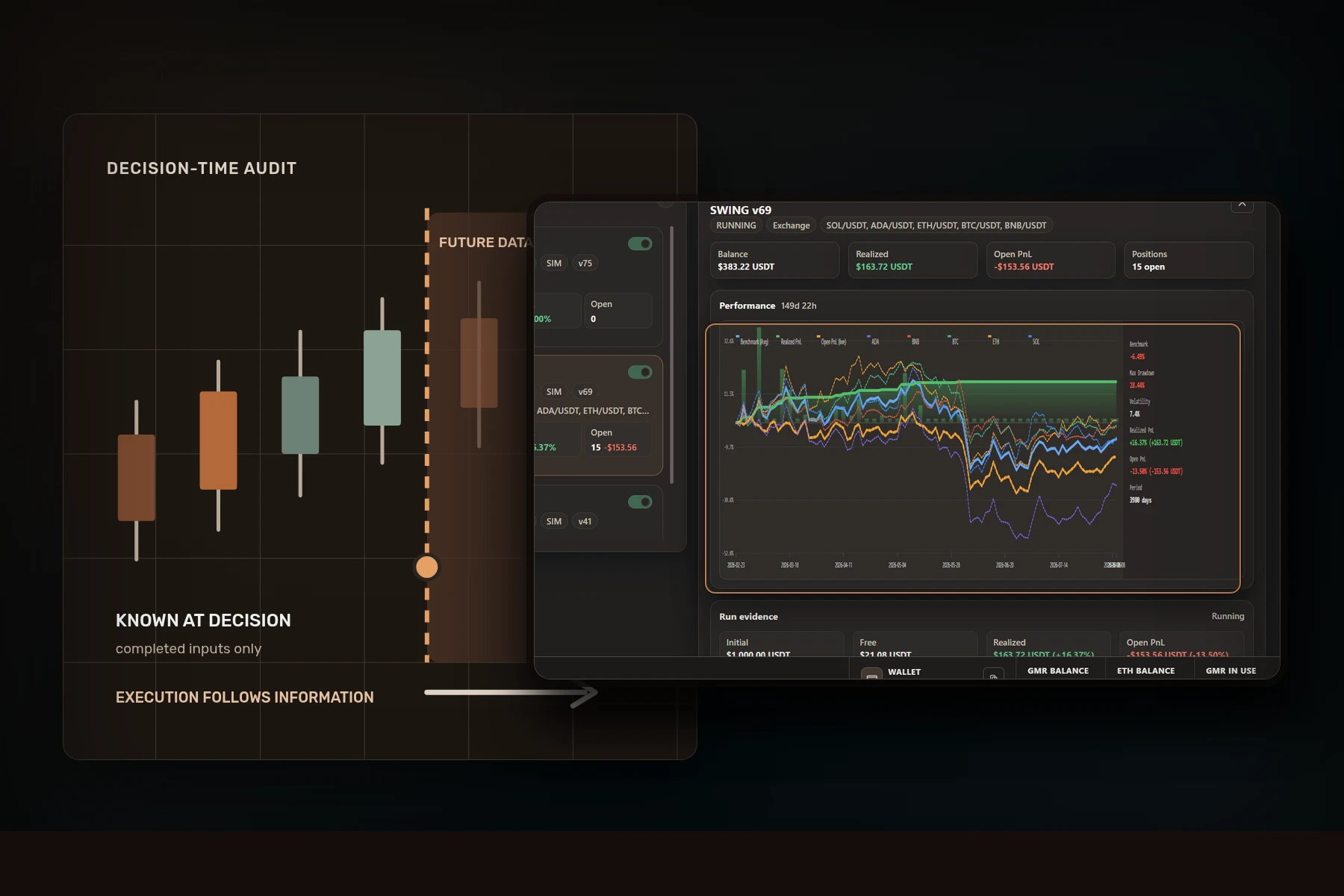
Crypto backtest look-ahead bias happens when a simulated decision uses information that was not available at that point in history. The leak can come from a completed candle, a future row, a revised indicator, a data join, or parameter tuning. The result may look precise while testing a decision the bot could not have made in real time.
The practical fix is to treat every backtest decision as a timestamped evidence check: what was known, when was it known, and what price could realistically be used next?
What look-ahead bias means in a crypto backtest
A backtest replays historical data through a set of rules. Look-ahead bias enters when a rule, feature, or simulated fill sees beyond the decision timestamp. It is a data-availability error, not simply an optimistic assumption.
That distinction matters because a strategy can use accurate historical data and still use it too early. The final high, low, close, and volume of a five-minute candle are factual after the interval ends. They were not all knowable halfway through that candle.
Official scikit-learn time-series validation documentation explains why ordinary cross-validation is inappropriate for time-ordered data when it trains on future samples and evaluates on earlier ones. Preserving order is necessary, but it is only one part of the audit. Features, joins, fills, and tuning choices must respect time too.
A candle-close example
Suppose a rule evaluates a five-minute candle from 10:00 through 10:04:59 and buys when its close is above a moving average.
- Before the interval closes: the final close and full volume are still changing.
- At the completed-candle decision: the final candle can inform the signal, subject to the dataset’s timestamp convention.
- After the decision: the test needs a price that was actually available after the signal became knowable.
A biased test may calculate the signal from the completed close and also fill at that exact close without modeling whether the decision and execution could occur in that order. A more defensible test might use the next available price, or it might use an intrabar model with explicit event ordering and latency. There is no universal one-bar rule. The key is that the fill cannot happen before the information that triggered it existed.
TradingView’s official strategy documentation notes that historical and realtime behavior can diverge when a strategy depends on information that is not available on the latest bar. That is a useful diagnostic idea, not a statement about Gimmer or any exchange integration.
Five common paths for future data to leak in
1. Reading a candle before it is complete
A rule uses the final close, high, low, or volume while also acting as though those values were known earlier in the interval. Multi-timeframe strategies are especially vulnerable when a higher-timeframe candle is merged into lower-timeframe rows before it closes.
2. Using centered or revised features
A centered moving average, a backward-filled future value, or an indicator that revises earlier output can make historical signals cleaner than the signals available in sequence. Inspect the feature calculation, not just the chart it produces.
3. Joining data by date instead of availability time
Market, reference, funding, or external data may be recorded for the same date but published at different times. A join can attach a later observation to an earlier decision unless it uses the timestamp when the value became available.
4. Normalizing with the full dataset
Scaling a feature with the minimum, maximum, mean, or volatility of the entire test period lets future observations influence earlier inputs. Fit transformations only on the information available to the relevant training window, then apply them forward.
5. Tuning and reporting on the same period
Repeatedly changing thresholds after reading one period’s results leaks knowledge through the research process, even when the strategy code never accesses a future row. Keep development, tuning, and evaluation windows separate. The guide to using out-of-sample data in crypto strategy backtesting explains how to preserve that boundary.
Crypto backtest look-ahead bias audit
- Define the decision timestamp. State whether the rule evaluates at candle open, during the interval, at candle close, or after another event.
- List allowed inputs. For every field, record when it becomes available and whether it can be revised later.
- Align every timeframe. Do not expose a completed hourly candle to a five-minute decision that occurred before the hour ended.
- Model execution after information. State the delay, price source, spread, fees, partial-fill assumption, and any intrabar ordering.
- Fit transformations in sequence. Calculate normalization, feature selection, and model parameters only from the permitted historical window.
- Separate tuning from evaluation. Freeze the strategy before reading the held-out period. Record every retry or parameter search.
- Inspect individual trades. For several entries and exits, reconstruct the exact data available at the decision and the next eligible execution point.
- Run a delay sensitivity check. Shift execution later or remove the newest input. A sharp unexplained collapse is a reason to investigate, not automatic proof of bias.
Before this audit, verify that the underlying candles are complete and consistently timestamped. The crypto backtest candle-quality checklist covers gaps, duplicates, ordering, time zones, and incomplete intervals. Data quality and look-ahead control are related, but neither substitutes for the other.
Keep execution assumptions in a separate column
A timestamp-safe signal can still produce an unrealistic backtest if the fill model assumes an unavailable price. For each simulated trade, keep two records:
- Decision evidence: timestamp, completed inputs, feature values, and rule outcome.
- Execution assumption: eligible price time, order type, size, spread, fees, slippage, and final state.
This separation makes diagnosis easier. If a result changes, you can tell whether the cause was a signal-timing correction or a cost and fill assumption. The crypto trading bot fee checklist provides a separate framework for testing cost sensitivity.
What a clean backtest can and cannot tell you
Removing an identified look-ahead path improves the integrity of the historical experiment. It does not prove that the strategy will perform similarly in a new market period.
A defensible interpretation is narrow: under the documented data, timing, cost, and execution assumptions, these rules produced these historical outcomes. Changes in liquidity, volatility, latency, venue behavior, data coverage, or market regime can produce different results.
Gimmer’s public backtest guide frames the workflow as a way to challenge a strategy, not approve it automatically. It asks operators to review dates, costs, drawdown, open exposure, trades, and out-of-sample evidence. When results appear, use the guide to reading Gimmer backtest results without turning a chart into a promise to keep the conclusion proportional to the evidence.
Crypto backtest look-ahead bias FAQ
Is using the current candle always look-ahead bias?
No. It depends on which values are used, when the decision occurs, and how the data is timestamped. A completed candle can inform a later decision. Using its final values before completion, or filling before the signal was knowable, creates the problem.
Does a chronological train and test split remove all look-ahead bias?
No. It prevents one important class of future-to-past training leakage. Feature calculations, higher-timeframe joins, normalization, revised data, execution timing, and repeated tuning can still leak information.
Can a high return prove that a backtest has look-ahead bias?
No. An unusually strong result is a reason to audit assumptions, not proof of a particular defect. Reconstruct timestamped decisions and eligible fills instead of diagnosing from one headline metric.
Conclusion
Crypto backtest look-ahead bias is best treated as an evidence-ordering problem. Define the decision time, permit only data available then, place execution after the signal, fit transformations in sequence, and keep the final evaluation separate from tuning.
Next step: open Gimmer’s backtest guide and write down the decision timestamp, allowed inputs, candle-completion rule, execution delay, and evaluation window before interpreting the next result.
The Gimmer Team
Pingback: Crypto Backtest Market Regimes: Test the Same Rules Across Different Conditions – Gimmer – Automated Crypto-Trading