
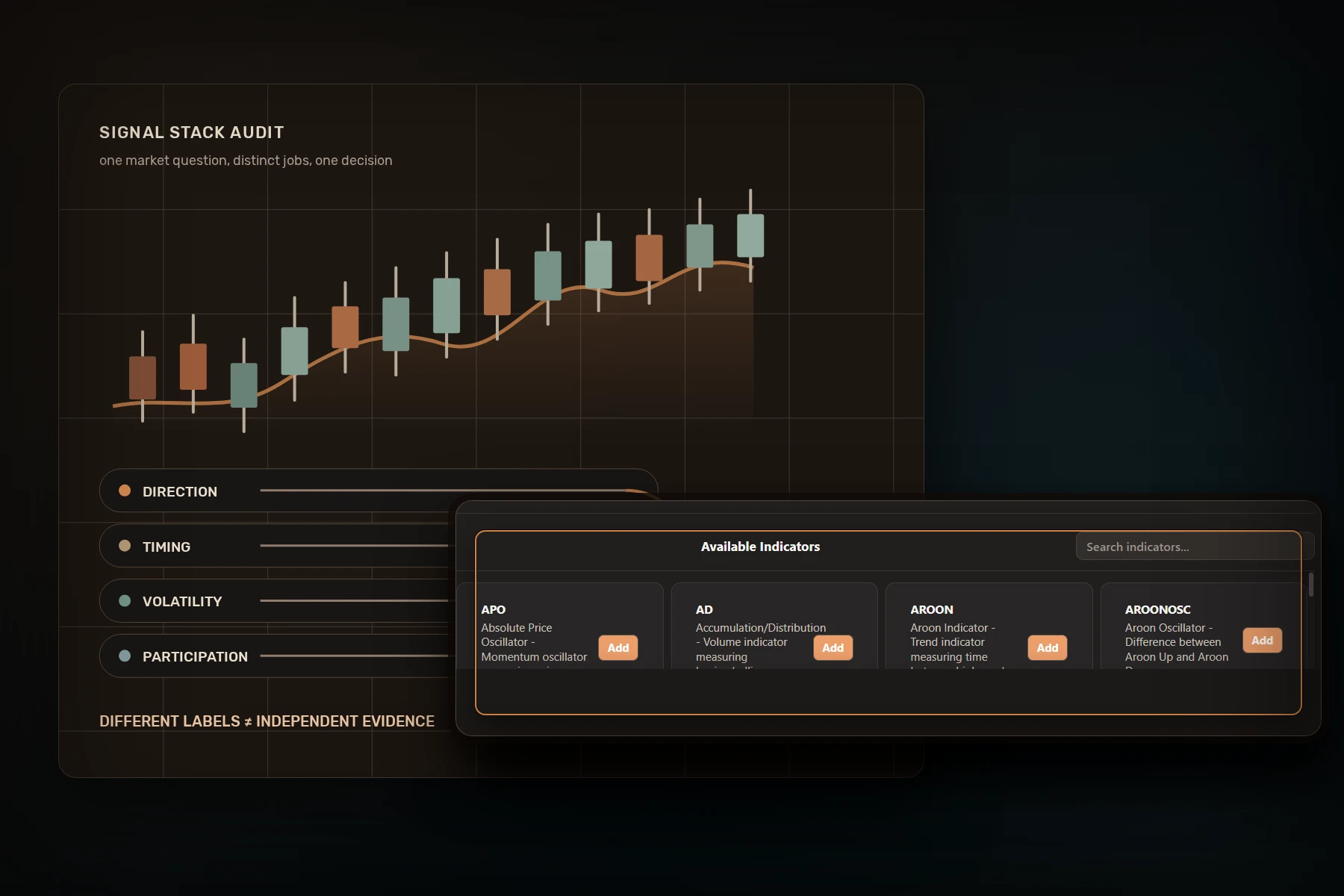
Crypto trading bot indicators are useful only when each one answers a clear question. Adding three signals derived from similar price data does not create three independent confirmations. Start with one market thesis, assign each indicator one job, remove repeated evidence, and lock the rules before you read a backtest. The goal is a signal stack you can explain and challenge, not a crowded chart that looks convincing after the fact.
Gimmer’s Indicators reference follows the same practical boundary: choose one thesis, select evidence that adds information, configure the exact window, and test the completed rules across more than one market condition.
What a crypto trading bot indicator should contribute
An indicator transforms historical inputs into a value or condition. It can describe direction, momentum, volatility, participation, or another market property. It cannot guarantee the next move, the execution price, or the outcome of a strategy.
Before adding an indicator, finish this sentence: “I need this signal to tell the strategy whether…” If the answer is the same as an indicator already in the stack, the new signal may be repetition rather than confirmation.
| Signal job | Question it should answer | Example family | Redundancy warning |
|---|---|---|---|
| Direction | Is a directional move established? | Trend or moving average | Several averages can repeat the same price evidence. |
| Timing | Is movement accelerating, slowing, or crossing a threshold? | Momentum or oscillator | Different oscillators can react to the same recent closes. |
| Regime | Has the volatility environment changed? | Volatility or range | A historical volatility measure is not a maximum future move. |
| Participation | Does available volume evidence support the price move? | Volume or accumulation | One venue’s volume does not represent the whole crypto market. |
Not every strategy needs all four jobs. A narrow first revision may need only direction and timing. The framework is a way to expose missing or duplicated reasoning, not a required template.
Build one thesis before choosing indicators
The Gimmer strategy-building guide recommends keeping the first version reviewable. Apply that idea before opening an indicator catalog.
Write the market question
Use a question that can be answered from defined data at a defined time. “Is the completed candle still inside an established trend?” is testable. “Is this coin ready to pump?” is vague, promotional, and impossible to audit consistently.
Name the decision and invalidation
State what the signal can change and what would make the thesis invalid. Entry logic, exit logic, position sizing, and risk controls are separate decisions. A strong indicator reading should not silently override an exposure limit or a failed order state.
Choose the candle interval deliberately
A 14-period calculation represents different spans on 15-minute, four-hour, and daily candles. Record the interval with the parameter. A period without its candle interval is an incomplete specification.
Run a five-question redundancy check
Indicator names are not enough to prove that signals add separate information. Use these five questions before the first backtest:
- Input: Do both indicators use the same close, high-low range, volume series, or derived input?
- Transformation: Are they both smoothing, ranking, or comparing the same data in a similar way?
- Window: Do their lookback periods cover nearly the same observations?
- Timing: Do they usually change state on the same completed candle?
- Counterfactual: If one indicator is removed, does the strategy make materially different decisions?
A “yes” does not automatically disqualify a pair. It tells you to justify the pair as one combined rule rather than count it as two independent confirmations.
Compare a crowded stack with a reviewable stack
Consider two illustrative designs. They are not Gimmer results, recommendations, or evidence of future performance.
| Design | Signal stack | What is easy to explain | Main review risk |
|---|---|---|---|
| Crowded | Three moving-average variants plus two momentum oscillators | Most signals agree after a sustained move. | Repeated price evidence can look like broad confirmation. |
| Reviewable | One trend condition, one timing condition, and one volatility filter | Each rule has a named job and a visible counterfactual. | The smaller stack can still be wrong or overfit. |
The reviewable design is not “better” by definition. It is easier to inspect. If the crowded stack earns its complexity on locked, unseen data, keep the evidence. If removing one signal changes nothing, remove the decoration.
Lock the rules before reading the result
Multiple-signal strategies create many choices: which indicators, parameters, thresholds, logical relationships, markets, intervals, and dates to use. Trying enough combinations on the same history can make noise look selected and intentional.
Robert Novy-Marx’s primary research on backtesting strategies based on multiple signals shows how combining and selecting from many candidate signals can intensify overfitting bias. That research is not about Gimmer or cryptocurrency specifically. It supports the general discipline of recording the search space and challenging a selected design on data that did not choose it.
If parameters will be explored systematically, use the Strategy Optimizer guide to keep the source revision, bounded parameter space, run history, and selected candidate visible. A top-ranked historical candidate remains a candidate.
Test the stack in a fixed sequence
- Write the market question, decision time, candle interval, and allowed inputs.
- Give every indicator one named job.
- Record parameters, thresholds, inversion, and logical relationships.
- Run the redundancy questions and remove rules that do not change the decision.
- Lock the strategy revision before opening the evaluation period.
- Use the Running Backtest guide to review trades, costs, open exposure, drawdown, and the full report together.
- Challenge the same revision on unseen dates and neighboring parameter values.
- Record failures and ambiguous decisions, not only the strongest result.
The companion article on out-of-sample crypto strategy backtesting explains why the later date range must remain closed until the rules are locked.
What this framework does not prove
A clean signal stack improves traceability. It does not establish statistical independence, execution quality, exchange support, safety, or future results. Historical candles cannot reproduce every spread change, partial fill, outage, queue delay, liquidation path, or intervention.
Gimmer exposes the current indicator catalog and configuration workflow. This article does not claim that Gimmer automatically measures correlation, removes repeated signals, detects overfitting, or approves a strategy for live use.
Crypto trading bot indicator FAQ
How many indicators should a crypto trading bot use?
There is no universal number. Use the smallest stack that answers the strategy’s defined questions and changes decisions in a way you can explain. Complexity must earn its place in testing.
Are two different indicators independent?
Not necessarily. They may share the same input, transformation, lookback window, or signal timing. “Different name” and “different job” are not the same as statistical independence.
What should I test after choosing indicators?
Test the locked revision across different market conditions, realistic costs, unseen dates, and neighboring parameter values. Then inspect the underlying trades and failed or ambiguous states, not only the summary curve.
Conclusion
Choose crypto trading bot indicators by job, not by popularity. Start with one market question, remove repeated evidence, record every rule, and lock the stack before evaluating it. A simpler strategy is not automatically effective, but it is easier to challenge honestly.
Next step: open Gimmer’s Indicators reference, write one market question, choose one indicator for each distinct job the first revision needs, and lock that stack before the first backtest.
The Gimmer Team