
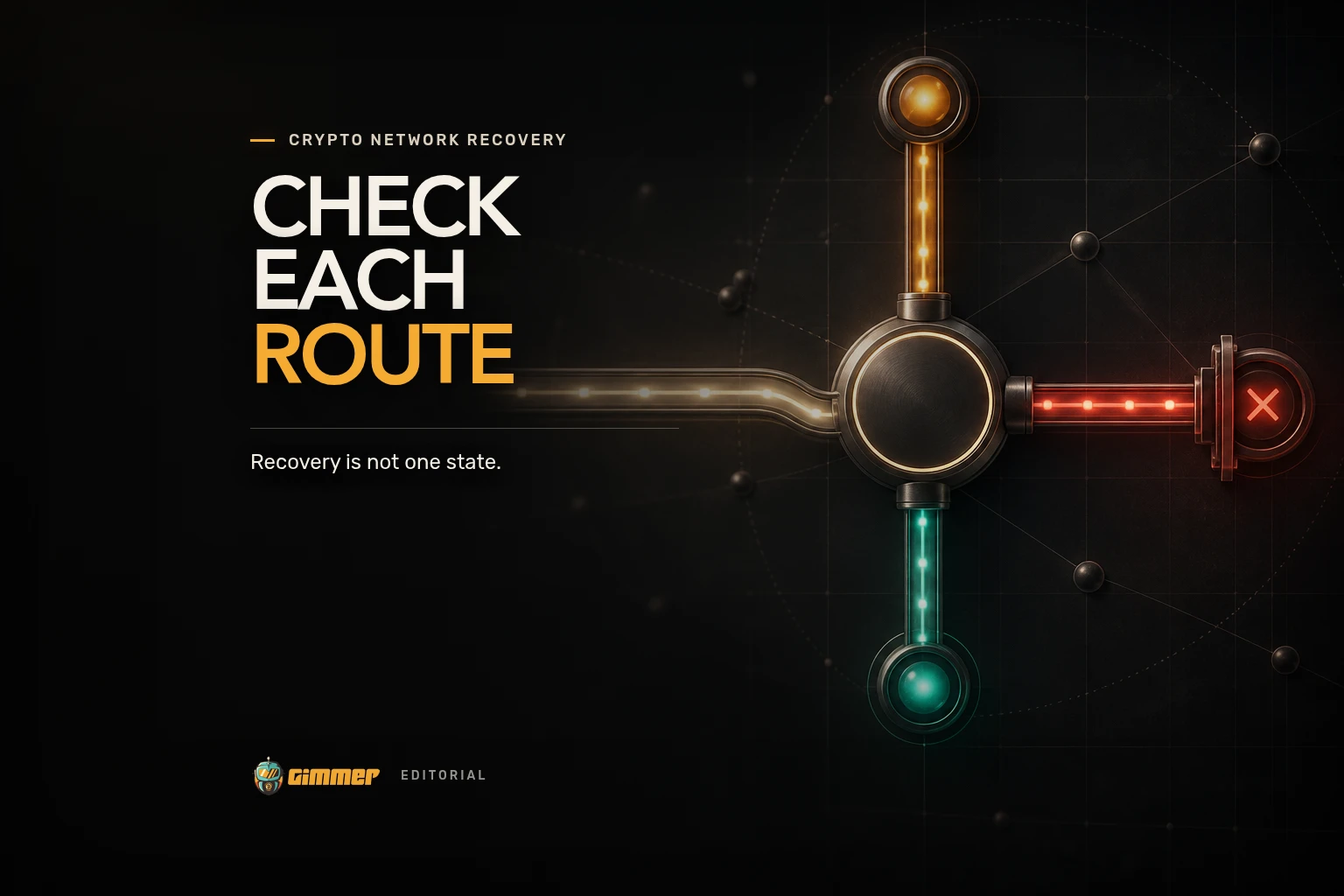
Crypto network recovery is not a single green light. Blockstream’s September 10 incident update said Liquid block production had resumed while peg operations remained suspended. SideSwap then reopened its markets and, on September 11, its own peg-in service—but peg-out stayed closed. The practical question is therefore not “Is Liquid back?” It is “Is the exact operation I need available, and what evidence proves its final state?” Before an automated retry or resume, check the network component, service route, transaction identifier, and external source of truth separately.
What changed on September 10 and 11
Blockstream’s active Liquid security-incident page described a controlled resumption on September 10. It said required functionary and bridge-node updates had been deployed and block production had resumed, while peg operations remained suspended during the next recovery stage.
Later on September 10, SideSwap said its swaps and markets were open again. On September 11, the company published a narrower update: peg-in through SideSwap had reopened, while peg-out remained closed.
Those statements describe different layers and different owners. Blockstream reports network-level recovery work. SideSwap reports the state of its own markets and peg service. Neither statement proves the status of another venue, another route, or one user’s transaction. The event is useful precisely because its states do not collapse into one answer.
“Back online” is a stack, not a switch
A crypto workflow can look healthy at one layer while another layer remains unavailable. The Liquid technical overview distinguishes block-signing functionaries from the watchmen involved in the bitcoin peg. That architecture explains why block production and peg availability are related but separate operating questions.
The same separation appears in automation. A process can be running while its exchange connection is stale. A market can be visible while deposits or withdrawals are paused. A request can leave the local application while the external service has not reached a final state.
Use five layers when reading any recovery message:
- Process: Is the local application or bot running?
- Network: Are blocks, nodes, or the relevant API advancing?
- Market or service: Is the exact trading, swap, deposit, or withdrawal surface open?
- Route: Is the direction you need available? Inbound and outbound routes can differ.
- Transaction: Does the specific instruction have a confirmed external final state?
A green answer at layer one cannot stand in for layer five.
A crypto network recovery matrix for this event
The table below maps the public evidence available when this article was checked on September 11, 2026. It is an incident-reading framework, not a recommendation to use Liquid, SideSwap, L-BTC, or any particular route.
| Layer | Public evidence | What it does not prove |
|---|---|---|
| Network liveness | Blockstream reported controlled block production had resumed. | That every transaction type or external service is available. |
| SideSwap markets | SideSwap reported swaps and markets open on September 10. | That peg-in and peg-out share the same state. |
| SideSwap peg-in | SideSwap reported its peg-in service open on September 11. | That L-BTC can currently be redeemed through peg-out. |
| Peg-out | Blockstream and SideSwap said peg-out remained suspended or closed. | When it will reopen or what another provider will do. |
| One transaction | Unknown until its identifier and external status are checked. | That a timeout, local error, or running process means success or failure. |
The matrix prevents a category error. “Markets open” is evidence about markets. “Peg-in open” is evidence about an inbound service operated by SideSwap. Neither is permission to rewrite “peg-out closed” as “the network is fully recovered.”
What Gimmer can and cannot show
Gimmer’s Simulation and Live guide separates runtime activity, positions, orders, and final execution status. It also says that a network timeout does not prove an order failed and that stopping a bot does not necessarily close positions or cancel external orders.
The current Gimmer product overview makes the same boundary visible from another angle: a strategy decision and external execution are different stages. Balance, permission, allowance, nonce, liquidity, network, or venue errors can still prevent an intended action from completing.
For an always-on deployment, Gimmer’s operating guide for a VPS or dedicated host warns that a running process can still have a stale exchange connection or a stuck strategy. It recommends monitoring expected candle activity, pending order state, network reachability, and restart evidence rather than process uptime alone.
These Gimmer surfaces can help you inspect a Gimmer-supported workflow. They do not monitor Liquid, SideSwap, Blockstream, or another venue on your behalf. Gimmer does not certify this incident’s recovery, and this article does not claim support for Liquid or L-BTC. The external network, venue, wallet, or explorer remains the source of truth for its own state.
Before you retry or resume
- Name the exact operation. “Use the network” is too broad. Write down the market, swap, deposit, withdrawal, peg direction, or order action you need.
- Check the primary status owner. Record the component, state, update time, and source URL. Do not rely on a screenshot or social summary without opening the source.
- Check the service operator. A network-level recovery does not prove that one exchange, bridge, or wallet route has reopened.
- Preserve identifiers. Keep the transaction or order ID, request time, account or wallet context, and last externally confirmed state.
- Compare local and external evidence. A local “submitted,” “running,” or timeout message is not a terminal external result.
- Restart one component at a time. The Gimmer always-on guide recommends recording restart times and checking the last processed candle before live execution is enabled again.
- Do not retry an unknown state blindly. Reconcile first so a delayed acknowledgement does not turn a second instruction into duplicate exposure.
- Observe one controlled step. If the required route is explicitly available, verify the next expected evaluation and final state before returning to unattended operation.
If local records were restored during the interruption, use Gimmer’s backup and recovery checklist to compare local positions, pending orders, balances, and connected accounts with the external state before restarting a strategy.
Crypto network recovery FAQ
Does resumed block production mean deposits and withdrawals work?
No. Block production is one layer. Exchanges, bridges, deposits, withdrawals, and direction-specific routes can remain paused or follow different recovery schedules. Check the exact operation with its responsible service.
Should I retry a transaction after a network interruption?
Not from a timeout or local error alone. Preserve the identifier and check the relevant wallet, explorer, exchange, or service for a final state. If a Gimmer-supported workflow remains unclear, wait or use Gimmer’s official support path; for a third-party service, use only that provider’s official channel rather than responding to unsolicited messages.
Treat each route as its own state
Crypto network recovery is clearest when every claim names a component and an owner. The September 10–11 Liquid sequence shows why: block production, markets, SideSwap peg-in, and peg-out did not all change state together.
Next step: open Gimmer’s Simulation and Live guide and write the exact external route, evidence owner, transaction identifier, and final-state check for one supported workflow before you resume it.
Pingback: Crypto Server Update Checklist: What Bitcoin Core 32.0rc1 Teaches Operators – Gimmer – Automated Crypto-Trading