
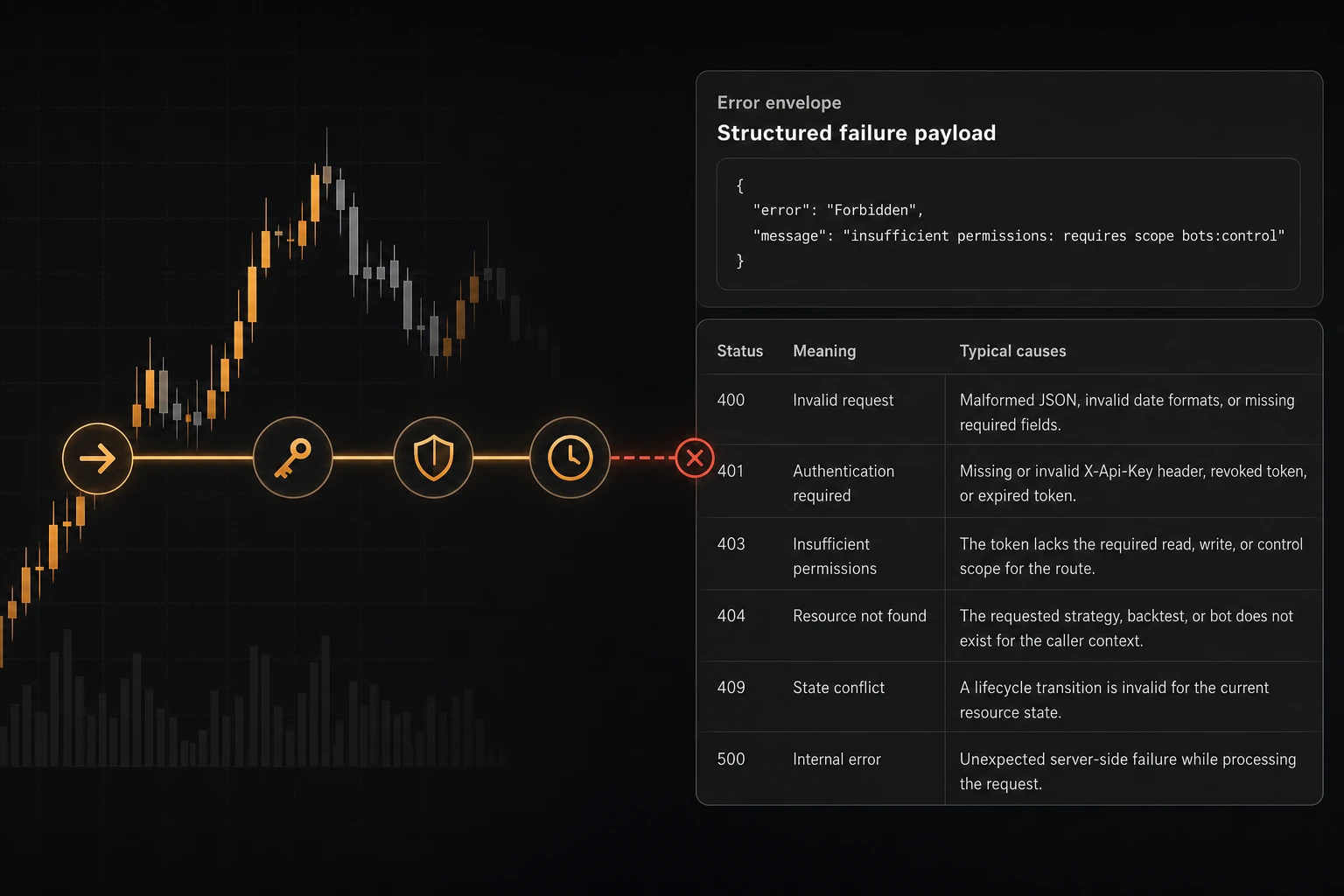
When an API call fails, the status code is the beginning of the diagnosis, not the conclusion. A missing token, an under-scoped token, malformed JSON, a state conflict, a server-side failure, and a throughput problem each call for a different next step. Gimmer’s public API docs put those distinctions in one place: a status matrix, a structured error/message payload, an explicit scope model, and conservative rate-limit guidance.
This is a practical triage guide for crypto trading API and blockchain-integration work. It is not a promise that reading a status code will make an integration succeed. The goal is smaller and more useful: classify the failure before you rotate credentials, broaden permissions, or replay a write.
Start With the Status and the Body
The first reliable habit is to preserve two pieces of evidence together:
- the HTTP status code; and
- the structured response body, especially
errorandmessage.
Gimmer’s Errors chapter shows the failure shape as a small JSON object:
{
  "error": "Forbidden",
  "message": "insufficient permissions: requires scope bots:control"
}
The body gives context, while the status gives you the first branch in the decision tree. Do not replace both with a generic client message such as “request failed.” A caller who keeps the status and message can ask a much narrower question: is the request malformed, is the caller unauthenticated, is the token under-scoped, is the resource or lifecycle state wrong, or is the failure outside the client request?
400: Check the Request Shape
The documented 400 Bad Request class is for an invalid request: malformed JSON, invalid date formats, or missing required fields. This is a payload problem first, not a reason to change the token.
For a cryptocurrency automation integration, inspect the serialized body before sending it again. Check that the JSON is valid, dates use the documented format, required fields are present, and values belong to the route you selected. If the request contains a strategy, backtest, or bot identifier, confirm that the payload matches that route instead of copying fields from a neighboring endpoint.
Keep the correction narrow. Fix the body, run the smallest safe validation request, and only then move to a larger workflow. Replaying the same malformed request faster does not create better evidence.
401: Check Authentication
A documented 401 Unauthorized response points to authentication: a missing or invalid X-Api-Key header, a revoked token, or an expired token. For the public v1 examples, verify the header and token state before you inspect scopes.
That distinction matters because authentication and authorization are different checks. A token cannot be evaluated for the right scope if the API has not accepted the token as a valid credential in the first place. Confirm that your client is sending the header expected by the public v1 route, that the value is the intended token, and that the token has not expired or been revoked.
Do not paste the token into an article, screenshot, support message, shell history, or log just to make the failure easier to reproduce. Use a placeholder in examples and keep the real credential in the appropriate protected workflow.
403: Check the Permission Boundary
A documented 403 Forbidden means the server will not allow the requested operation. It may be a missing scope or another route-level permission/precondition; inspect the structured error/message and route contract before changing scopes. If the message explicitly names a scope, compare that route requirement with the token’s narrow scope set.
Gimmer’s API docs separate capabilities such as strategies:read, strategies:write, backtests:read, backtests:write, bots:read, bots:control, and events:read. Compare the route’s documented requirement with the token’s actual scope set. Use the narrowest documented scope that satisfies the route; do not broaden a read call with write or control access merely for client convenience.
In the structured example above, the response names bots:control. That is actionable because it tells the caller which permission boundary to review. It does not mean the caller should add every available scope, and it does not mean the failed request should be retried until the server accepts it. Update the token policy deliberately, then rerun one bounded request.
404 and 409: Check Resource and Lifecycle State
Not every failure is an auth failure.
404 Not Found means the route did not return the requested strategy, backtest, or bot. Check the identifier and route contract before changing credentials; do not infer from the status alone whether the resource is missing or outside the caller’s visibility.
409 Conflict means a lifecycle transition is invalid for the current resource state. This is the class to respect when a client tries to start, stop, end, pause, resume, or otherwise change a resource at the wrong point in its lifecycle. Read the current state, reconcile it with the action you intended, and avoid sending the same transition repeatedly while the state is unclear.
500: Do Not Turn a Server Error Into a Retry Loop
The documented 500 Internal Error class describes an unexpected server-side failure while processing the request. It is not enough information to conclude that the API is unavailable, that a trading workflow is unsafe, or that a client retry will fix the problem.
Preserve the status, a redacted error/message, method/route, request or correlation ID if provided, and timestamp. Before storing or sharing, remove X-Api-Key/authorization headers, query parameters, request bodies, wallet or personal data, and raw logs. If a real token may have been exposed, revoke it and issue a replacement.
Stop treating the response as a payload or scope problem unless the returned message provides evidence for that interpretation. For write-side calls, especially those that can change strategy or bot state, do not send rapid duplicate requests while the first outcome is uncertain. Follow the route’s documented confirmation or read-back path and escalate with the bounded evidence if the mismatch persists.
Rate-Limit Signals Need Retry Discipline
Gimmer’s current Rate Limits chapter is deliberately guidance-first. It says to use one SSE subscription for progress-driven workflows instead of replacing a stream with tight polling, to apply backoff and idempotency when the route contract supports it, and for desktop/API consumers to reuse the same stream semantics rather than spawning duplicate confirmation channels.
The chapter does not publish a universal numeric quota, a guaranteed 429 response, a Retry-After header, or a route-wide idempotency guarantee. Do not invent one of those details in a client or in support content. If the API path or an upstream gateway returns a rate-limit signal, classify it as a throughput and retry condition rather than as proof that the token is invalid or under-scoped. Slow the client down, preserve the response, and confirm the current route contract before trying again.
For asynchronous backtests and other progress-driven workflows, use one SSE subscription rather than a tight polling loop. For write calls, apply bounded backoff and retry only when the route’s idempotency and confirmation semantics are documented. A faster loop can create duplicate actions or make a transient response harder to interpret.
A Small Triage Sequence for API Integrations
When a request from a crypto trading API client fails, use this order:
- Save the HTTP status and structured
error/messagebody. - If it is
401, verify the public-v1X-Api-Keytransport and token state. - If it is
403, inspect the structured error/message and route contract; only adjust scopes when the response explicitly names a missing scope. - If it is
400, correct the JSON, dates, required fields, or route-specific payload. - If it is
404or409, verify the resource identifier and current lifecycle state. - If it is
500, stop blind retries and preserve bounded evidence for the next diagnosis. - If it is a rate-limit signal, apply conservative backoff and the route’s confirmed retry/idempotency rules instead of changing credentials.
- Rerun the smallest safe, preferably read-only, request. For a write, reconcile the prior outcome first and retry only when the route’s idempotency and confirmation semantics are documented; otherwise use the documented read-back or support path.
This sequence does not tell you what a market will do, whether a strategy will perform, or whether an integration is ready for live automation. It keeps the API diagnosis honest so those decisions are not built on a misread error.
What This Guide Does Not Promise
- It does not promise that a valid token will make every request succeed.
- It does not turn a
403into a recommendation to grant broad permissions. - It does not publish a numeric rate limit, a universal
429contract, or a guaranteed retry header. - It does not replace route-specific API documentation, QA, or support evidence.
- It does not promise exchange coverage, wallet safety, trading performance, profitability, or future results.
Final Thoughts
A useful API error guide should reduce guesswork, not add confidence that the evidence cannot support. Read the status, read the structured message, compare the result with authentication and scope rules, then choose the smallest correction. When throughput or asynchronous work is involved, use the current backoff and stream guidance rather than turning uncertainty into a retry storm.
Open #/docs, review Errors, compare 401/403 with Authentication and Scopes, then review Rate Limits before you change credentials, broaden scopes, or replay a write. Rerun only the smallest safe request after the cause is understood.
– The Gimmer Team